
Real Estate Investment in Tunisia: Is It Really Profitable in 2026?
⟳ Machine translation
By the menzili.tn editorial team, a real estate listings portal in Tunisia covering all 24 governorates. Published on 29 September 2026. Next update scheduled for March 2027.
Buying an apartment to rent it out is still the number one wealth-building reflex in Tunisia. But does that reflex hold up against the numbers? In 2026, a rented home earns an average gross yield of 5.35% a year, a special savings account guarantees at least 6%, and inflation hovers around 5.4%. Put that way, the verdict looks bad for property. In reality it is more nuanced: everything depends on the city, how you finance the purchase and how prices evolve. Here is the full calculation, source by source, prepared by the team at menzili.tn, the property listings portal covering all 24 governorates of Tunisia.
Rental Yields in Tunisia: The Real Figures for 2026
The average gross rental yield on a home in Tunisia is 5.35% in 2026, according to Global Property Guide (September 2026 update). After vacancy, maintenance and costs, the net yield generally falls to between 3.3% and 3.9%. Tunis beats the national average; Nabeul does far worse.
Tunisia Lags Behind Its Mediterranean Neighbours
Tunisia's rental yield is one of the lowest in the region. Morocco stands at 7.36%, Egypt at 7.47% and Turkey at 7.86%, again according to Global Property Guide. Why the gap? Purchase prices have risen faster than rents in recent years, which mechanically squeezes yields. In other words, Tunisian landlords pay a high price for the right to collect a modest rent.
Big Differences Between Cities
The average hides wide disparities. In the second quarter of 2025, apartments in Tunis earned an average gross yield of 7.24%, compared with about 5.4% in Ariana, 5.15% in Ben Arous and only 3.91% in Nabeul. Nabeul tells the story well: prices there are pushed up by seaside demand (Hammamet in particular), while year-round rents stay modest. In practice, an investor chasing pure rental yield is better off looking at a small, well-located apartment in Tunis than at a beachfront residence.
One caveat: these figures are averages based on asking prices and asking rents in listings, not actual transactions. A property negotiated 10% below its listed price improves its yield by the same proportion.
From Gross to Net Yield: What Eats Into Your Rent
The net yield on a rental investment in Tunisia is 1.5 to 2 points lower than the gross yield. Three items explain the gap: acquisition costs (at least 6% of the price for resale properties), running costs and vacancy, and the income tax due on rent.
Purchase Costs: At Least 6% on Resale Properties
For an apartment bought from a private seller, the buyer pays a registration duty of 5% of the price, plus 1% for the land registry (Conservation de la Propriété Foncière). The Registration and Stamp Duty Code also imposes a supplementary duty, calculated on the full price, of 2% on properties worth between 500,000 and 1 million dinars, and 4% above 1 million. Example: an apartment sold for 600,000 TND pays 12,000 TND in supplementary duty, not 2,000 TND. A common trap: if the deed does not show that duties were paid on the previous sale, an additional 3% duty becomes payable. Check this point with your notary or lawyer before signing.
New-build homes bought from a licensed developer follow a different regime, with VAT included in the price. We covered it in detail in our guide to VAT on new homes (in French). Finally, non-resident individuals who pay for their home entirely in foreign currency benefit from a fixed registration fee instead of the proportional duty, and are exempt from the 2% or 4% supplementary duty: a real advantage for Tunisians living abroad. Note, however, that a buyer of foreign nationality still needs the prior authorisation of the governor to purchase outside tourist zones.
Tax on Rental Income: a 20% Allowance, Not 30%
Rent falls into the property income category and is added to your other income when calculating tax. Article 28 of the Personal Income Tax Code (Code de l'IRPP) sets the flat allowance at 20% of gross rent, on top of which you can deduct documented repair and maintenance costs and the built property tax (TIB) paid. Many websites still quote a 30% allowance: that rate was lowered by Law No. 2015-53 of 25 December 2015 (the 2016 Finance Law). On 12,000 TND of annual rent, the difference means 1,200 TND more in taxable income.
Vacancy, Maintenance, Building Fees: the Forgotten Costs
One month without a tenant each year means 8.3% less rent. Add minor works between tenancies, your share of building management fees and the built property tax, and you understand why a yield advertised at 5% rarely ends up above 4% in the owner's pocket.
Capital Gains: Are Prices Rising Faster Than Inflation?
Prices of built property in Tunisia rose 5.6% year on year in the fourth quarter of 2025, according to the National Institute of Statistics (INS). With average inflation of 5.3% in 2025, the real gain at national level is close to zero. The Sahel region does much better than Greater Tunis.
Greater Tunis vs the Sahel: Two Different Markets
The INS data show a clear contrast. In Greater Tunis, built property prices rose 2.9% over the year, which is a decline in real terms once inflation is deducted. In the Sahel region (Nabeul, Sousse, Mahdia, Monastir), the increase reached 6.9%. This is the Nabeul paradox again: weak rental yield, but stronger price momentum. Choosing a city therefore means trading off rent against capital growth.
A Signal to Watch: Transactions Are Falling
In the last quarter of 2025, the volume of apartment sales fell 4.9% compared with the previous quarter, according to the INS. Prices rising while sales fall is often the sign of a slowing market. In practice, that means more room to negotiate for the patient buyer, and less certainty for anyone betting on a quick rise.
What About Capital Gains Tax?
Capital gains on the resale of a property are taxable. The Personal Income Tax Code does, however, exempt the first sale of a single residential unit, provided the declared price is below 500,000 TND and the total area does not exceed 1,000 m². For the calculation, the purchase price is increased by 10% for each year of ownership, which sharply reduces the taxable gain on long holding periods.
Property or Bank Savings: The Comparison
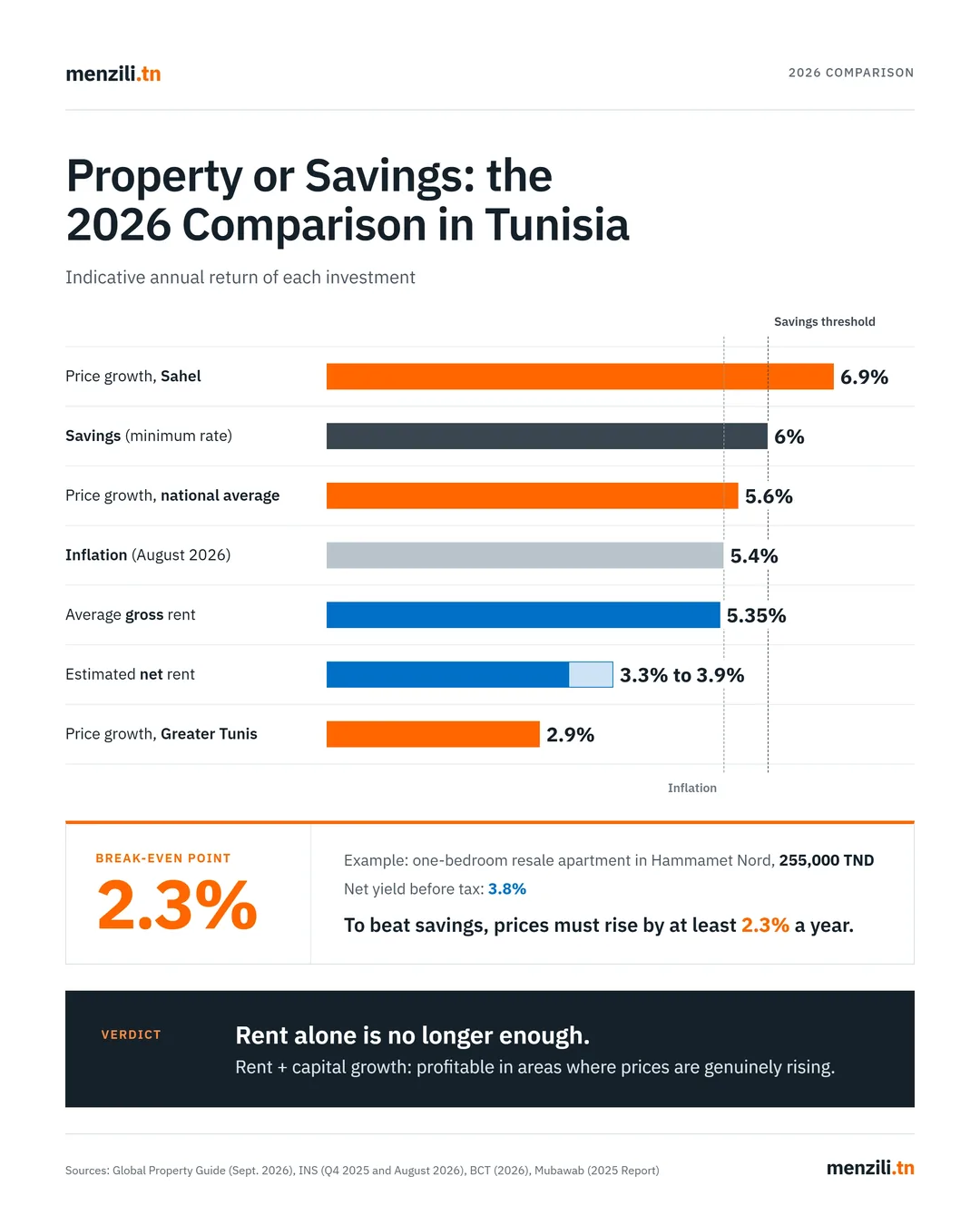
On rent alone, a rental property in Tunisia earns less than a special savings account in 2026. The investment beats savings only if prices in the area rise by at least 2 to 3% a year, which is the case in the Sahel but not guaranteed in Greater Tunis.
| Investment | Indicative annual return | Source |
|---|---|---|
| Special savings account (minimum rate) | 6% | BCT, since January 2026 |
| Unfurnished rental, average gross yield | 5.35% | Global Property Guide, Sept. 2026 |
| Unfurnished rental, estimated net yield | 3.3% to 3.9% | Gross minus 1.5 to 2 points |
| Price growth, national average | 5.6% | INS, Q4 2025 year on year |
| Price growth, Greater Tunis | 2.9% | INS, Q4 2025 year on year |
| Price growth, Sahel | 6.9% | INS, Q4 2025 year on year |
| Inflation | 5.4% | INS, August 2026 |
Note: the comparison is made before tax on both sides. Both rental income and savings interest are taxable, so the return you actually receive depends on your tax situation.
Our reading is clear: buying for rent alone no longer makes financial sense in 2026, unless you negotiate the price hard. Buying for the combination of rent and capital growth remains relevant, provided you target an area where prices are genuinely rising and accept a major trade-off: an apartment cannot be sold in three days, unlike money in a savings account.
A Worked Example: a One-Bedroom Resale Apartment in Hammamet Nord
For a 75 m² one-bedroom resale apartment (S+1) bought in Hammamet Nord in 2026, the net yield before tax comes out at around 3.8%. The deal beats savings only if prices keep rising by at least 2.3% a year.
The starting figures come from Mubawab's 2025 property report: 3,400 TND/m² for resale properties in Hammamet Nord and an average rent of 1,025 TND a month for a one-bedroom apartment. The 75 m² surface, one month of vacancy a year and 1,000 TND of annual costs are our assumptions.
| Item | Amount |
|---|---|
| Purchase price (75 m² × 3,400 TND) | 255,000 TND |
| Registration duty and land registry fee (6%) | 15,300 TND |
| Total cost (excluding deed drafting fees) | 270,300 TND |
| Annual rent (12 × 1,025 TND) | 12,300 TND |
| Less 1 month of vacancy | 11,275 TND |
| Less costs (building fees, maintenance, TIB) | 10,275 TND |
| Net yield before tax | 3.8% |
Against 6% on savings, 2.2 points are missing, or about 5,950 TND a year. To close the gap, the property must gain at least 2.3% in value every year. If the pace seen in the Sahel in 2025 (6.9%) continued, the unrealised gain would reach about 17,600 TND over one year, and the total return would climb to around 10%. If it stops dead, the investment becomes less profitable than a simple savings account. One year of growth is not a forecast: that is the whole challenge of this kind of purchase.
Who Real Estate Investment Pays Off For (and Who It Does Not)
Rental property in Tunisia is profitable for a buyer who pays cash or close to it, targets a small unit in a high-demand area and holds the property for at least eight to ten years. It rarely is for a buyer who finances most of the purchase with a loan.
Borrowing Changes Everything
The Central Bank of Tunisia (BCT) kept its policy rate at 7% at its meeting of 29 July 2026, and the average money market rate (TMM) stood at 7.25% in June. A variable-rate mortgage costs this benchmark rate plus the bank's margin. Borrowing at more than 7% to earn 3.8% in net rent is negative leverage: every dinar borrowed costs more than it brings in as rent. Only capital growth can rescue the deal, which turns it into a bet on prices rather than an investment.
The Winning Profiles
Three situations clearly come out ahead:
- The patient cash buyer, who negotiates below the asking price and aims for a long horizon, where the 10% annual uplift of the purchase price limits capital gains tax.
- Tunisians living abroad who pay entirely in foreign currency: the fixed registration fee, with no supplementary duty, sharply reduces the entry cost.
- The small-unit investor in Tunis, where rental demand (students, young professionals, expatriates) supports the best yields in the country.
Conversely, the high end of Greater Tunis combines high prices with growth below inflation: it is the segment where profitability is hardest to defend in 2026.
Ready to compare? Browse apartments for sale in Tunis and in the Nabeul governorate, check current rents in apartments for rent in Tunis, or explore new-build projects for your yield calculation.
FAQ: Investing in Property in Tunisia
What is the average rental yield in Tunisia in 2026? The average gross rental yield is 5.35% according to Global Property Guide (September 2026). After costs, vacancy and charges, the net yield is generally between 3.3% and 3.9%.
Is it better to keep money in the bank or buy an apartment to rent out? On rent alone, a special savings account, paying at least 6%, earns more than an unfurnished rental. Property becomes more profitable again if prices in the area rise by at least 2 to 3% a year.
Are property prices still rising in Tunisia? Yes: the INS recorded a 5.6% year-on-year increase in the fourth quarter of 2025. Growth was 2.9% in Greater Tunis and 6.9% in the Sahel, while the number of apartment sales is falling.
What costs should I expect when buying a resale apartment? Allow 5% registration duty and 1% land registry fee, or 6% of the price. A supplementary duty, calculated on the full price, is added: 2% between 500,000 and 1 million dinars, 4% above that.
How is rental income taxed in Tunisia? Rent is property income added to your total income. The Personal Income Tax Code applies a flat 20% allowance, plus documented maintenance costs and the built property tax paid.
Sources: Global Property Guide (rental yields, September 2026); INS, Real Estate Price Index Q4 2025 and Consumer Price Index August 2026; Central Bank of Tunisia; Registration and Stamp Duty Code; Personal Income Tax and Corporate Tax Code (IORT 2024 edition); Mubawab, 2025 Property Report.