
Rent Increase in Tunisia: What a Landlord Can (and Cannot) Impose
⟳ Machine translation
Your landlord has just announced a 15% hike on next month's rent? Or, as a landlord, you wonder whether you can move from 900 to 1,000 TND? The question comes back every autumn, and it is sharper in 2026: according to the INS, Tunisia's national statistics institute, actual rents rose 5.85% year on year in September 2026, their steepest increase since July 2017. The catch is that a myth is everywhere: "the law caps rent increases at 5% a year". That cap does exist, but it only covers a very narrow category of old housing. This guide, prepared by the team at menzili.tn, the property listings portal covering all 24 governorates of Tunisia, links every rule to its legal source: the Code of Obligations and Contracts (COC), law no. 76-35 and the bill currently under review. Two free PDF templates, in French and Arabic, are waiting for you at the end.
Is there a legal rent increase rate in Tunisia?
No, not for recent residential leases. No Tunisian text currently sets a maximum increase rate for housing let under the COC: the rate is whatever the contract provides. The 5% annual cap only applies to old housing governed by law no. 76-35 of 18 February 1976.
Recent leases: the contract is the law between the parties
Renting a home in Tunisia falls under the COC, articles 727 onwards on the hire of things. The core principle is set by article 242: "Contractual obligations validly formed take the place of law for those who made them, and can only be revoked by their mutual consent or in the cases provided for by law." In practice, the rent written into the lease binds both landlord and tenant. The COC chapter on leases provides no mechanism for revising the rent during the lease: only the parties' agreement, expressed in a contract clause or a signed amendment, can change it. Our view: this is good news for both sides, provided the review rule is written down in black and white at signature.
Old leases: the 5% cap of law no. 76-35
Law no. 76-35 covers premises whose construction was completed before 1 January 1954 (article 1). Law no. 78-19 of 1 March 1978 extended it to premises built before 1 January 1970 and occupied under a lease on the date it was published. For these homes, article 17 provides that the rent "shall be increased by a maximum of 5% per year from 1 January 1976". A landlord who fraudulently exceeds this rate faces a fine of 500 to 5,000 TND (article 24). The full text can be consulted on the website of the Official Printing Office (IORT).
In practice, this regime mostly affects old buildings in city centres, in Tunis, Sfax or Sousse, let to the same families for decades. A flat built in 2015 in Ennasr or La Soukra is not concerned. Holiday premises and service accommodation are excluded (article 31).
| Criterion | Recent lease (COC) | Old lease (law no. 76-35) |
|---|---|---|
| Homes covered | Any home outside the scope of the 1976 law | Built before 1954, or before 1970 and let when law no. 78-19 was published |
| Increase rate | Freely set by the contract | 5% per year maximum (art. 17) |
| Increase during the lease | Only if a clause or amendment provides for it | Within the legal limit; authorised works (art. 7) |
| Penalty for abuse | Clause unenforceable, dispute before the court | Fine of 500 to 5,000 TND (art. 24) |
Sources: COC (articles 242 and 727 onwards), law no. 76-35 of 18 February 1976, law no. 78-19 of 1 March 1978.
Can the landlord raise the rent during the lease?
No, unless the contract contains a rent review clause. For the term of the lease, the agreed rent binds both parties (article 242 of the COC). Without a clause, the landlord cannot impose any increase before the expiry date; they can only propose one, and the tenant is free to refuse.
Take a common case: a one-year lease signed on 1 March 2026 for a two-bedroom flat in Ariana, at 1,000 TND a month, with no review clause. In September, the landlord announces that the rent goes up to 1,100 TND from October. Legally, this announcement has no force: the tenant can keep paying 1,000 TND until 28 February 2027. Only a new agreement, accepted and signed by the tenant, would change that.
And if the contract does provide for an increase? Then it applies, but exactly as written. A clause stating "the rent shall be increased by 5% on each anniversary of the contract" allows 5%, not 8%. This is the logic of article 5 of the menzili.tn rental agreement template, which lets the parties set that rate at signature. One detail matters: the increase runs from the agreed date, never retroactively.
Raising the rent at the end of the lease: the right method
At expiry, the landlord can propose a new rent, provided they act before the end of the term. If the tenant stays in the property without objection, the lease is renewed on the same terms (article 793 of the COC), so at the same rent. To avoid this, notice must be given before expiry, together with a figure.
The COC is clear on this. A fixed-term lease ends when the term expires, with no need to give notice (article 791). But if the tenant continues to occupy the property, tacit renewal applies, on the same terms and for the same period (article 793). It does not apply when notice or an equivalent act has expressed the wish not to renew (article 794). Letting the expiry date pass without a word therefore means renewing the old rent for another year.
The method that works, in three stages:
- At least two months before expiry (the period set by article 19 of our template, check yours): send a notice letter with a proposed new rent, through a bailiff (huissier de justice) or by registered letter with acknowledgement of receipt.
- Before expiry: give the tenant a reasonable time to reply, fifteen days for example, and stay open to negotiation.
- At expiry: if you agree, sign an amendment or a new contract at the new rent, then have it certified and registered like the original lease. If the tenant refuses, the lease ends and the tenant must vacate; if they refuse to leave, only a court decision can order eviction.
Our advice to landlords: back your request with comparable listings rather than a percentage pulled out of thin air. A reliable tenant who leaves often costs more, between a month of vacancy and minor refurbishment, than a moderate increase that gets accepted.
Drafting a valid rent review clause
A valid review clause sets three things in advance: the rate or calculation rule, the date it applies and how often. Drafted precisely, it avoids any argument at each expiry. A vague clause such as "the rent may be revised" does not allow the landlord to impose an amount.
Three formulas come up in Tunisian leases:
- Fixed annual rate: "the rent is increased by 5% on each anniversary of the contract". It is the simplest and most predictable; we recommend it for a residential lease.
- Fixed rate at each renewal: the increase only applies at renewal, for example every two years. More favourable to the tenant, it stabilises the relationship.
- Inflation indexation: the rent follows the price index published by the INS. The formula seems fair, but it must name the exact index, its reference date and the calculation method. As there is no clear case law on this point for housing, have this type of clause reviewed by a lawyer.
To see the effect of a rate, here is how a 1,000 TND rent evolves with an increase applied every year:
| Monthly rent | 3% a year | 5% a year | 10% a year |
|---|---|---|---|
| Year 1 (signature) | 1,000.00 TND | 1,000.00 TND | 1,000.00 TND |
| Year 2 | 1,030.00 TND | 1,050.00 TND | 1,100.00 TND |
| Year 3 | 1,060.90 TND | 1,102.50 TND | 1,210.00 TND |
| Year 4 | 1,092.73 TND | 1,157.63 TND | 1,331.00 TND |
| Year 5 | 1,125.51 TND | 1,215.51 TND | 1,464.10 TND |
| Year 6 (after 5 increases) | 1,159.27 TND | 1,276.28 TND | 1,610.51 TND |
| Total increase | +15.9% | +27.6% | +61.1% |
menzili.tn calculation: compound increases on an initial rent of 1,000 TND. For reference, inflation was 5.6% year on year in October 2026 (INS).
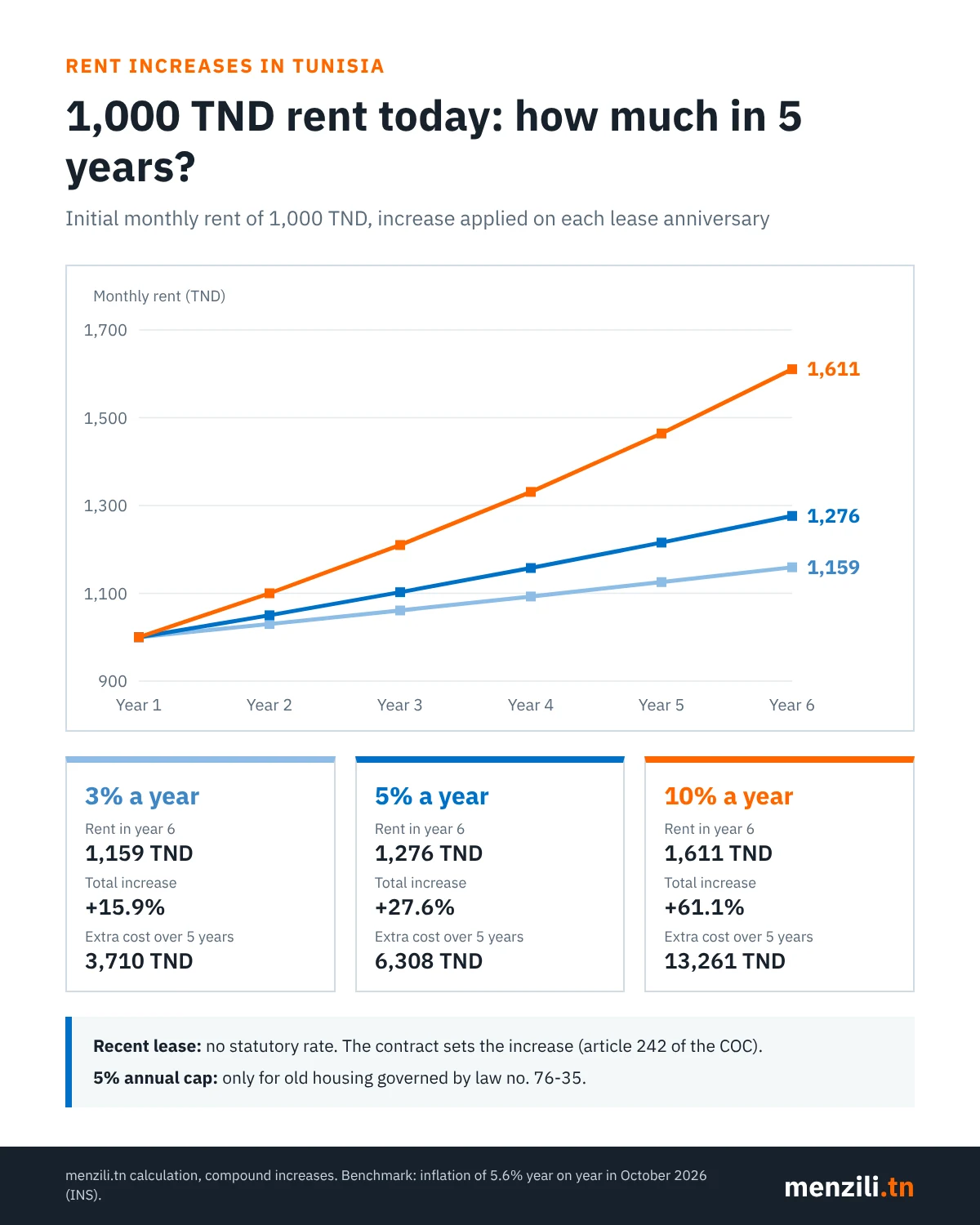
The difference is far from trivial: at 10% a year, the tenant pays 13,261 TND more over five years than with a fixed rent, against 3,710 TND at 3%. Note that commercial leases follow other rules. Law no. 77-37 of 25 May 1977 organises a court-ordered rent review (article 24), only possible after three years and if the rental value has changed by more than a quarter (article 25). Nothing comparable exists for housing: do not transpose these rules to a flat.
What a landlord can never do
Whatever the contract says, a landlord cannot take the law into their own hands. Cutting off water or electricity, changing the locks, withholding the deposit or demanding a retroactive increase to force a rise are illegal practices. Only a judge can order a tenant's eviction.
These pressures are more common than you might think, especially when a landlord wants to re-let at a higher price. Here are the red lines:
- Cutting off STEG or SONEDE supply (electricity, gas and water), or asking the building manager to do so: this is an unlawful act, expressly prohibited by article 17 of our template.
- Changing the locks or emptying the home while the tenant is away: even with unpaid rent, only a court decision allows eviction.
- Withholding the deposit to make up for a refused increase: the deposit covers damage and unpaid rent, not a rent the tenant never accepted.
- Demanding a retroactive increase on months already paid at the agreed rate.
- Imposing a new rent by simple text message during the lease, without a clause or written agreement.
A tenant facing these practices should document everything (messages, photos, bailiff's report) and consult a lawyer without delay.
Tenants: how to respond to a rent increase
Faced with a rent increase request, the tenant should first reread the contract: it is the contract that says whether the increase is due. If it is not, reply in writing, keep paying the agreed rent and keep proof of every payment. If it is, check that the amount claimed matches the clause exactly.
The process, step by step:
- Reread the lease: review clause, rate, expiry date, notice period.
- Reply in writing, by registered letter or dated e-mail, quoting the relevant article of the contract. Avoid purely verbal arrangements.
- Negotiate with figures: compare your rent with similar listings on menzili.tn, such as flats for rent in Tunis, Ariana or Sousse, and check the price barometer in Rental mode.
- Pay the agreed rent without interruption, preferably by bank transfer, so as never to give grounds for termination for non-payment.
And if the landlord refuses to accept the old rent to push you into giving in? The COC provides the answer: the debtor makes a formal tender of payment and, if it is refused, discharges the debt by depositing the sum (article 289). No tender is needed if the creditor has already declared that they refuse payment (article 291), and the costs of a valid deposit are borne by the creditor (article 301). In practice, this procedure goes through a bailiff; a lawyer will tell you how to start it in your case.
Rent caps: where does bill no. 2025/113 stand?
Bill no. 2025/113 on relations between landlords and tenants is not in force. Tabled on 7 October 2025 at the Assembly of the Representatives of the People, it was still under committee review as of 13 November 2026. Its caps therefore apply to no lease today.
According to the official ARP page, the bill was tabled by eleven MPs, then referred on 29 January 2026 to the General Legislation Committee, which examined it on 3 and 26 February 2026. It has not been put to the plenary. Its 24 articles provide in particular for:
- a written contract following a standard template;
- rent ceilings set by the Ministry of State Domains and Land Affairs;
- increases limited to 5%, no more than five times, and no increase during the first two years;
- no eviction before three years of tenancy;
- a deposit capped at two months' rent;
- payment of rent and deposit through the municipal tax collector, and the creation of a municipal lease office.
The bill is divisive, including within the committee, where the rapporteur expressed reservations in March 2026. Our reading: it will probably change before any vote. Be wary of posts presenting it as an adopted law. We will update this article as soon as an official stage is reached.
Free templates: rent review amendment and new rent letter
To move from theory to practice, menzili.tn offers two free templates, in French and Arabic, to fill in and print:
- Rent review amendment: to record in writing a new rent accepted by both parties, during the lease or at renewal. Download in French (PDF) | Download in Arabic (PDF)
- Notice letter with a proposed new rent: to send to the tenant before the lease expires. Download in French (PDF) | Download in Arabic (PDF)
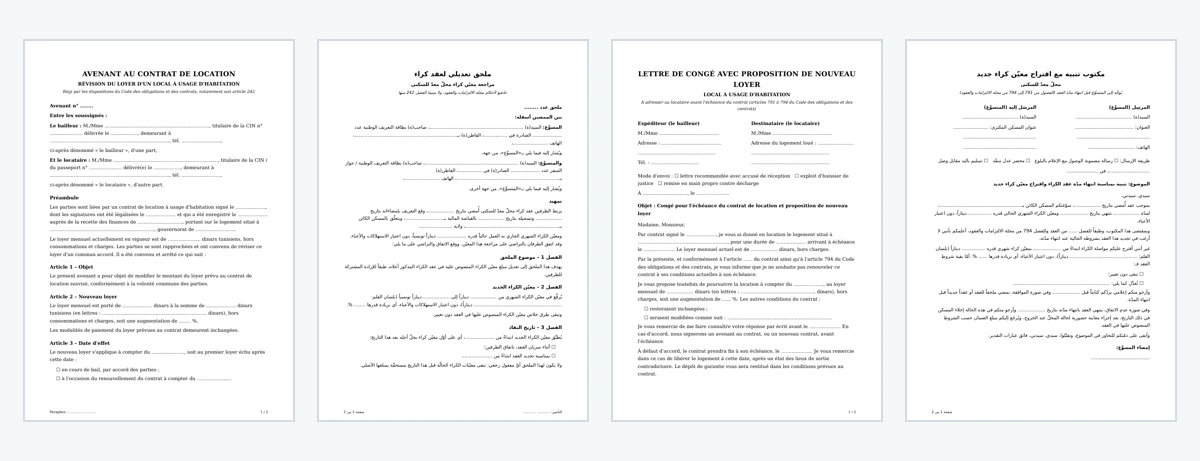
These templates are provided for guidance only. They complement our guide to rental agreements in Tunisia and its lease template. If you are a landlord thinking about the rent to ask, our analysis is real estate investment in Tunisia profitable? gives actual yields. And to find a tenant at the right price, you can post your listing for free on menzili.tn.
Frequently asked questions about rent increases in Tunisia
What is the maximum rent increase percentage in Tunisia?
For a recent lease, the law sets no maximum percentage: the rate is the one provided by the contract. The 5% annual cap only applies to old housing governed by law no. 76-35 of 18 February 1976.
Can the landlord raise the rent every year?
Yes, if the contract includes an annual review clause, and only within the limit it sets. Without a clause, the landlord must wait for the lease to expire and obtain the tenant's agreement on a new rent.
What happens if I refuse the rent increase?
During the lease and without a clause, your refusal has no consequence: you keep paying the agreed rent. At expiry, if the landlord gave notice in time, refusing the new rent ends the lease and you must leave the property.
Does the rent go up with tacit renewal?
No, unless the contract says otherwise. Article 793 of the COC renews the lease on the same terms, so at the same rent. To raise it, the landlord must give notice before expiry with a new proposal.
Can the landlord ask for an extra deposit after an increase?
Only if the contract provides for it or if you agree in writing. Tunisian law currently sets no cap and no adjustment rule for the deposit on recent leases.
Is the law capping rents at 5% in force?
No. Bill no. 2025/113 was still under committee review at the Assembly of the Representatives of the People as of 13 November 2026. Until it is passed and published in the Official Journal (JORT), it applies to no lease.
This article is for information only and does not replace advice from a lawyer. Texts consulted: Code of Obligations and Contracts (articles 242, 289, 291, 301, 727 onwards, 791 to 794), law no. 76-35 of 18 February 1976, law no. 78-19 of 1 March 1978, law no. 77-37 of 25 May 1977, ARP page for bill no. 2025/113, INS data (November 2026).